New vs. Used Pallet Racking: Which Is the Better Investment for Indianapolis Warehouses?
12 min read · May 2026 · Indy Pallet Racking Team
Every Indianapolis warehouse operator buying racking eventually confronts the same question: new or used? There is no universal right answer. The correct choice depends on your system type, budget, operational timeline, load requirements, and — in some Indy industries — compliance documentation requirements that take the decision out of your hands entirely. Indianapolis sits at the crossroads of the Midwest, a major distribution and manufacturing market with a uniquely deep pool of both new rack suppliers and quality used inventory. This guide gives Indy-area warehouse operators the framework to make the call correctly.
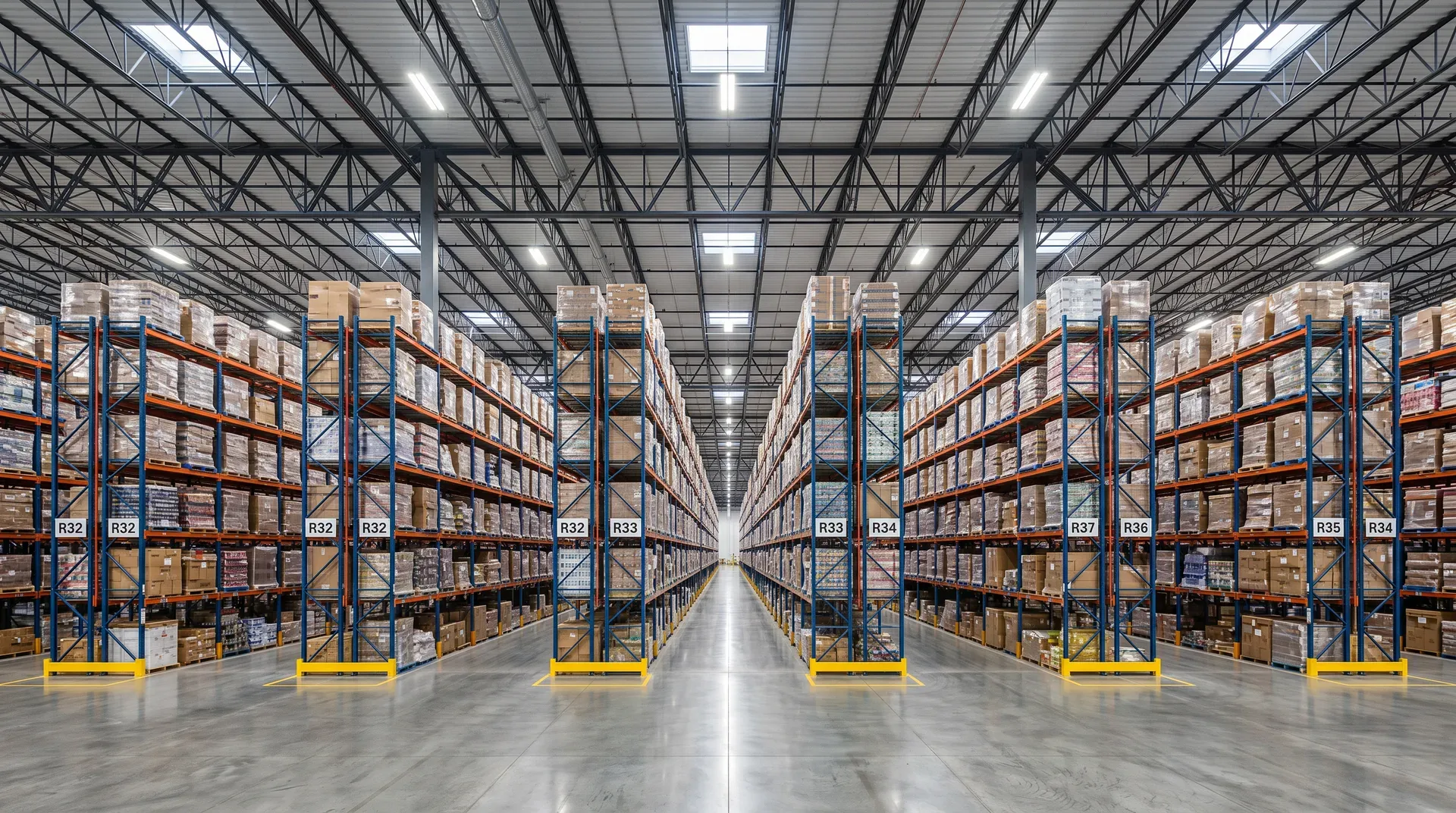
New vs. Used Pallet Racking at a Glance
Before diving into the details, here is a direct comparison of the key decision variables:
| Factor | New Rack | Quality Used Rack |
|---|---|---|
| Cost per pallet position (materials only) | $80–$150 | $35–$65 |
| Installed cost per pallet position | $100–$200 | $50–$100 |
| Lead time | 4–10 weeks | 1–3 weeks (when in stock) |
| Manufacturer warranty | Yes (10–25 years typical) | None (inspection cert only) |
| Color availability | Any | Orange/blue Teardrop most common |
| System types available | All types | Selective only (mostly) |
| ANSI/RMI documentation | Full — ships with system | Requires re-certification |
The Case for New Pallet Racking
Custom Configurations and Specialized Systems
If your project involves anything beyond standard selective racking, the choice is effectively made for you: drive-in rack, push-back rack, pallet flow, carton flow, and cantilever systems are essentially only available new. You will rarely find a complete, usable set of push-back carts or pallet flow lanes in the used market, and mixing components from different manufacturers in these systems is a structural and safety problem, not just a cosmetic one.
Indianapolis's industrial mix makes this directly relevant. The city's automotive supply chain — Indiana hosts major assembly plants and hundreds of Tier 1 and Tier 2 suppliers across Greenfield, Shelbyville, Columbus, and the ring counties — frequently requires FIFO pallet flow systems for time-sensitive components with traceability requirements. Eli Lilly and the broader pharmaceutical corridor through Fishers and Zionsville require validated storage environments with full documentation chains. High-cube distribution facilities in the LEAP district in Lebanon and the Plainfield/Avon corridor — many in the 36–40 foot clear height range — require engineered drive-in or push-back systems where the structural drawings must come from the original manufacturer.
New rack also lets you specify custom bay depths and widths for non-standard pallet sizes, choose zone-coding colors that match your warehouse management system, and integrate column protectors, wire deck styles, and row spacers as a designed system rather than assembled mix of compatible parts.
Manufacturer Warranty and Industry Compliance
New rack ships with a complete package: ANSI/RMI-compliant engineering drawings, stamped load calculations, load placard specifications, and a manufacturer warranty that typically runs 10 to 25 years on structural components. For industries where your customers, insurers, or internal quality systems audit your storage infrastructure, this documentation matters.
Indianapolis has a significant pharmaceutical and life sciences presence — Eli Lilly is headquartered here, and a cluster of contract manufacturers and biotech companies has built up around the I-69 corridor in Fishers and Noblesville. GMP-regulated facilities often require full component traceability for storage equipment. An inspection certificate on a used rack system generally does not satisfy that requirement. If you are operating in a regulated environment, check your quality management requirements before assuming used rack is on the table.
The same applies to certain insurance and lending requirements. Some commercial property insurers and equipment financing lenders specify that racking above certain heights must carry an active manufacturer warranty. If your lender or insurer has this language in your policy or loan covenants, read it before committing to used rack.
Long-Term Predictability at Indy's Scale
Indianapolis is not a satellite market — it is one of the Midwest's primary distribution hubs, and many of the warehouse facilities here are designed to operate for 20 to 30 years. For a permanent, high-cube facility where racking will approach 30 to 40 feet and be in daily service for decades, the predictability of a new system is genuinely valuable.
With new rack, you know the steel grade, the column section, the beam moment of inertia, and the manufacturer's engineering basis. When you need to add a level or extend a bay in year 10, you can source matching components directly from the manufacturer. When a forklift clips an upright in year 15, you replace it with an identical component from the same spec. With a used system assembled from multiple sources, that continuity is much harder to guarantee.
For large, permanent Indianapolis distribution operations — whether in the airport logistics cluster in Plainfield, the I-70 East corridor, or the north suburban industrial parks in Westfield and Noblesville — the long-term operational simplicity of a new system can justify the higher upfront cost, particularly when the facility is expected to change hands or tenants over its life and rack documentation becomes part of the building's value.
The Case for Used Pallet Racking
40–60% Savings: Real Numbers for an Indy Project
The savings on quality used rack are not incremental — they are material. Here is a real-world example for an Indianapolis warehouse buildout:
- Project size: 400 pallet positions, standard selective racking, 16-foot uprights, 96-inch bay width
- New rack, installed: approximately $160,000
- Quality used rack, installed: approximately $80,000
- Savings: $80,000
That $80,000 does not disappear — it stays in your business. For a company opening its first Midwest distribution point in Indianapolis, that capital can fund an additional month of operating runway, additional material handling equipment, a warehouse management system implementation, or simply reduce the amount of capital at risk in a new market entry.
Indianapolis's position as a Midwest distribution crossroads attracts a steady flow of companies opening their first Indiana facility — third-party logistics providers, regional e-commerce operations, and national retailers building out Midwest distribution networks. For these operators, capital efficiency on the racking buildout is a legitimate operational priority, not just a cost-cutting exercise. A properly inspected used rack installation that passes engineering review and local permitting delivers the same pallet positions as a new system — at half the cost.
Lifespan: Quality Used Rack Outlasts the Myths
The common assumption that used rack is "worn out" racking reflects a misunderstanding of how structural steel ages. Unlike mechanical components — motors, conveyors, forklifts — steel rack does not have a fatigue cycle that accumulates from normal use. A selective rack upright that has been properly loaded, never overloaded, and never subjected to forklift impact has essentially the same structural capacity on day 5,000 as it did on day one. The steel has not fatigued. The section has not changed.
ANSI/RMI MH16.1 — the standard that governs industrial steel storage rack — does not establish an age limit for racking. It establishes condition requirements. A 15-year-old upright that passes a professional inspection has been evaluated against the same structural criteria as a new upright. If it passes, it is structurally equivalent for the application.
The practical implication: quality used selective rack that passes a professional inspection can deliver 20 or more additional years of service without meaningful performance degradation. The caveat is the "quality" and "passes inspection" parts — which we address in the safety section below. The myth that used rack is inherently shorter-lived than new rack is not supported by the engineering standards that govern this industry.
Indianapolis Availability: A Deep Midwest Market
Indianapolis generates a consistent and substantial supply of quality used selective racking, and the reasons are structural to the local economy. The city sits at the convergence of I-65, I-70, I-74, and I-465 — a logistics crossroads that makes it a natural hub for distribution and manufacturing activity, which in turn creates steady rack turnover.
The automotive sector is particularly significant. Indiana hosts major assembly plants — the Stellantis plants in Kokomo and Belvidere, Subaru's only North American plant in Lafayette, Honda's large facility in Lincoln, and dozens of Tier 1 and Tier 2 suppliers throughout Marion, Hamilton, Madison, and Delaware Counties. When an automotive supplier consolidates operations, retools for a new platform, or responds to a production shift, large quantities of specialized racking come to market — often in excellent structural condition because automotive facilities tend to maintain their equipment well and operate within load limits. These consolidation events are one of the best sources of quality used rack in the Indy market.
Beyond automotive, pharmaceutical rightsizing from the Eli Lilly corridor, retail distribution center upgrades and tenant changeovers, food and beverage plant closures, and the Indy area's active 3PL sector all release quality used selective rack on a regular basis. The typical available inventory in the Indianapolis market is Teardrop-style selective racking in heights from 8 to 24 feet — the most common and interchangeable system type in North American warehousing.
Indy Pallet Racking sources, inspects, and reconditions used rack from regional suppliers throughout Central Indiana. When inventory is available from our regional network, lead times for used rack installations typically run one to three weeks from quote to install — considerably faster than the four to ten weeks required for new rack from the manufacturer.
ROI Comparison: 15-Year Total Cost of Ownership
Comparing rack on purchase price alone understates the true picture. Here is a 15-year total cost of ownership analysis for a 500 pallet position selective racking project in Indianapolis:
New Rack — 500 Positions
- Installed cost$125,000
- Maintenance / repair (15 yr est.)$8,000
- Total 15-year cost$133,000
- Annual amortized cost$8,867 / yr
Quality Used Rack — 500 Positions
- Installed cost (incl. inspection)$62,500
- Maintenance / repair (15 yr est.)$12,000
- Total 15-year cost$74,500
- Annual amortized cost$4,967 / yr
15-year savings with quality used rack: approximately $58,500.
The used rack scenario assumes slightly higher maintenance costs over 15 years — because you may need to replace individual damaged components more often without the manufacturer warranty backstop, and because older components are more likely to need replacement after forklift impacts. Even with that premium factored in, the total cost advantage of quality used rack over the life of a typical Indianapolis warehouse is substantial.
Important Qualifier
These savings only apply to properly inspected, grade-certified rack from a qualified supplier — not ungraded liquidation rack from an auction or bankruptcy sale. Rack purchased without professional inspection and grading documentation cannot be safely loaded to any rated capacity and does not satisfy local permit requirements. The math above assumes rack that has been professionally inspected, graded, and documented.
What Makes Used Rack Safe — and What Doesn't
Inspection and Grading
ANSI/RMI MH16.1 provides a damage classification framework that professional inspectors use to evaluate used rack components. The categories are commonly expressed as a traffic light system:
- Green (OK to use): Component is within acceptable tolerance. No measurable deviation from plumb or straight. Suitable for installation at rated capacity.
- Yellow (monitor): Component shows wear or minor damage but remains within structural tolerance. Can be placed in service but requires regular monitoring and priority replacement.
- Red (remove from service): Component exceeds damage tolerance and cannot be safely used. Must be removed, replaced, and not resold as structural racking.
A professional inspection covers: upright columns for lateral bend and twist at any point along the column height, base plate integrity and anchor bolt condition, beam connector integrity and engagement depth, beam surface condition for any kinks or bows that affect moment of inertia, and the presence and legibility of any remaining load placard documentation.
When Indy Pallet Racking sources used rack, every upright and beam that enters our inventory goes through this process. Components that don't make the cut don't get sold as structural racking. That is the difference between buying graded used rack from a qualified supplier and buying unsorted rack from a liquidation auction.
What Disqualifies Rack from Reuse
Not all used rack is salvageable. The following conditions are disqualifying — rack with these defects should not be placed in service regardless of price:
- Bent uprights beyond tolerance: Any upright with a bend or bow that exceeds ANSI/RMI allowable damage parameters. A severely bent upright can lose 40 to 80% of its rated column capacity.
- Missing or damaged anchors: Uprights that were removed from a concrete floor without preserving base plate integrity, or that show evidence of anchor bolt shear damage.
- Cracked connector welds: Beam connector tabs that show cracking at the weld toe are a structural failure mode — not a cosmetic issue.
- Unengineered repair welds: Field welds on structural rack components made without engineering review. These are essentially impossible to evaluate without destructive testing and are a disqualifying finding.
- No load rating documentation and no ability to establish origin: Rack from unknown sources with no original documentation and no manufacturer identification cannot be rated by an inspector — the engineering basis for any capacity determination does not exist.
The short version: never accept rack from a general liquidation auction without professional inspection before installation. The savings on the purchase price are not worth the liability exposure or, more importantly, the safety risk.
Indiana Permit Requirements
Indiana requires building permits for permanent rack installations above certain heights, and the thresholds and processes vary by jurisdiction. Indianapolis/Marion County, Hamilton County (Carmel, Fishers, Noblesville), Hendricks County (Plainfield, Avon, Brownsburg), and Johnson County (Greenwood, Franklin) each have their own permitting offices, plan review requirements, and inspection processes.
For permit purposes, used rack must satisfy the same engineering documentation requirements as new rack. The inspector does not care whether your rack is new or used — they need stamped structural drawings, load calculations, and proof that the installed system complies with ANSI/RMI and local building code. This means your used rack installation must include a professional engineering review that results in stamped drawings, regardless of whether the rack originally had manufacturer documentation.
Indy Pallet Racking handles the permitting process throughout the Indianapolis metro as part of our installation service. We coordinate engineering review, prepare permit submissions, and manage the inspection process — so your team can focus on getting the warehouse operational rather than navigating local building department processes.
The Indianapolis Used Rack Market
Understanding why Indianapolis has a consistently healthy used rack market helps explain why quality inventory is available and what conditions drive it.
Indianapolis is genuinely at the geographic center of the Midwest's freight network. I-65 connects Chicago to Louisville. I-70 runs from Kansas City to Columbus. I-74 links Champaign to Cincinnati. I-465 loops the metro and connects all of them. This geometry makes Indianapolis a natural distribution hub, and it generates a high density of warehousing and light manufacturing activity within the metro and within a two-hour radius — all of which produces rack turnover.
The automotive sector drives a disproportionate share of the quality used rack supply. Indiana's position as a major automotive manufacturing state — with assembly plants and hundreds of Tier 1 and Tier 2 suppliers — means that production retoolings, platform changes, supplier consolidations, and EV transition reconfigurations regularly bring large quantities of well-maintained rack to market. When a Tier 1 stamping or injection molding supplier in Anderson, Kokomo, or Greenfield consolidates two facilities into one or retools for a new platform, the excess rack often enters the used market in near-new structural condition. Automotive facilities generally maintain their equipment to a higher standard than the rack's structural requirements demand — which means the used rack that comes out of these consolidations is often among the best quality available.
The pharmaceutical sector contributes differently. When Eli Lilly or a contract manufacturer in the Fishers corridor downsizes a storage area or reconfigures for new inventory profiles, quality selective rack comes available — but in smaller quantities and often with stricter documentation requirements for the seller. The e-commerce and 3PL sector contributes through tenant turnover in the Plainfield, Avon, and I-70 East industrial corridors, where distribution leases turn over more frequently than traditional manufacturing facilities.
The typical used rack available in the Indianapolis market is Teardrop-style selective racking — the most common and interchangeable system in North American warehousing — in upright heights from 8 to 24 feet and standard bay widths. When Indy Pallet Racking has inventory from our regional sourcing network, installations can typically move from quote to completion in one to three weeks.
How to Choose: A Decision Checklist
Use these checklists to resolve the decision for your specific project.
Choose New Racking If:
- Automotive or pharmaceutical compliance requires full manufacturer documentation and component traceability
- System type is drive-in, push-back, pallet flow, carton flow, or cantilever
- Custom dimensions or non-standard colors are required for your WMS or zone layout
- Load requirements are at the upper range of standard selective spec
- High-bay system (30+ feet) where PE-stamped engineered drawings from the original manufacturer are required by your jurisdiction
- Your commercial property insurer or equipment lender requires an active manufacturer warranty
Choose Used Racking If:
- Project is standard selective racking in common dimensions (8–24 ft uprights, 96-in bays)
- Budget savings of 40–60% on materials are meaningful to your project economics
- Color flexibility is acceptable — orange or blue Teardrop is not a problem for your operation
- Inspection-certified condition satisfies your compliance and insurance requirements
- You are fitting out an Indianapolis facility quickly to meet a go-live deadline and cannot wait 4–10 weeks for new rack lead times
- Local Indy sourcing reduces freight cost and delivery lead time
If you are still unsure after working through the checklist, the honest answer is to get a quote for both and compare. A reputable racking supplier should be able to give you a clear-eyed recommendation based on your project specifics — not a push toward whatever has the better margin for them. We give every Indianapolis customer our honest read on which option fits their project, and we stock and install both.
Get a Quote on New or Used Racking for Your Indianapolis Facility
We supply and install both new and quality-inspected used pallet racking throughout the Indianapolis metro. Tell us your project and we'll give you an honest recommendation.
Request Free QuoteReady to Optimize Your Warehouse?
Get a free estimate from Indianapolis's warehouse racking experts. We serve warehouses of all sizes throughout the Indianapolis, IN metro area.