Pallet Racking for Indianapolis E-Commerce Fulfillment Centers
11 min read · May 2026 · Indy Pallet Racking Team
E-commerce has transformed what warehouses are supposed to do — and nowhere is that transformation more visible than in Indianapolis. As one of America's premier distribution markets, Indianapolis has absorbed billions of dollars of e-commerce fulfillment investment over the past decade. The racking systems inside those facilities are not your grandfather's bulk pallet storage. E-commerce fulfillment demands a completely different approach to rack design, pick path planning, and WMS integration. This guide covers what Indianapolis-area fulfillment operators need to know.
Indianapolis's E-Commerce Geographic Advantage
The case for locating e-commerce fulfillment in Indianapolis starts with a single number: approximately 65% of the US population lives within a one-day ground shipping radius of Indianapolis. That coverage — achievable with standard UPS, FedEx, or USPS Ground service — means an Indianapolis fulfillment center can offer next-day delivery to most of the eastern United States without paying for expedited shipping rates.
For operators committed to two-day delivery promises and aiming to single-source their fulfillment rather than running a multi-node network, Indianapolis offers coverage that few other single-location markets can match. Chicago offers similar population reach but at a dramatically higher real estate cost. Columbus is close but lacks Indianapolis's highway infrastructure density. Louisville has the UPS Worldport advantage for air freight but less ground coverage to the Northeast.
The result: Indianapolis has become a default first choice for e-commerce brands building their initial fulfillment infrastructure and for 3PLs seeking a single national distribution point. Amazon's choice to build multiple large fulfillment centers here wasn't coincidental — it was a data-driven validation of what smaller operators have known for years.
The Plainfield/Avon Fulfillment Corridor
The highest concentration of e-commerce fulfillment activity in the Indianapolis metro sits west of the city, in the Plainfield and Avon corridor along I-70 between the airport and the I-70/I-465 interchange. Several factors make this submarket the epicenter of Indianapolis fulfillment:
- Airport proximity: Same-day air freight injection for e-commerce operations running late cutoffs depends on quick access to Indianapolis International Airport. The Plainfield corridor is 5–10 minutes from the terminal.
- FedEx Mid-America Hub: Collocating with the FedEx hub creates operational advantages for operators using FedEx as their primary carrier — faster pickup windows, lower staging requirements, and sometimes negotiated rate advantages.
- Modern building stock: The Plainfield/Avon corridor has received significant speculative industrial development in the past decade. 36-foot and 40-foot clear buildings with ESFR sprinklers, 175-foot building depths, and 50-foot column spacing are common — all ideal for e-commerce fulfillment racking configurations.
- Labor access: The west side of Indianapolis and Hendricks County offer a large warehouse workforce within a 30-minute commute, which matters enormously for fulfillment operations that staff up significantly during peak season.
Our Plainfield pallet racking page covers our specific experience and capabilities in this submarket.
High-SKU Fulfillment Racking: Designing for Thousands of Active SKUs
The defining characteristic of e-commerce fulfillment racking — compared to bulk distribution racking — is SKU count. A regional distribution center for a beverage brand might stock 100–200 active SKUs. An e-commerce fulfillment operation for a mid-size retailer might stock 10,000–50,000 active SKUs, with new SKUs rotating in constantly.
High-SKU racking design requires a fundamentally different approach:
- Forward pick face density: Each SKU needs a forward pick face — a location where pickers can select individual units. The number of unique forward pick locations determines how many SKUs can be active simultaneously without replenishment from reserve storage. A well-designed fulfillment center typically allocates 1.2–1.5 forward pick faces per active SKU to accommodate multiple storage locations for A-velocity items.
- ABC velocity stratification: Not all SKUs pick at the same frequency. A items (top 10% by pick volume) might account for 60–70% of order lines. Racking design should place A items in golden zone locations (waist to shoulder height) near the pick start point, with B and C items in less ergonomically optimal positions.
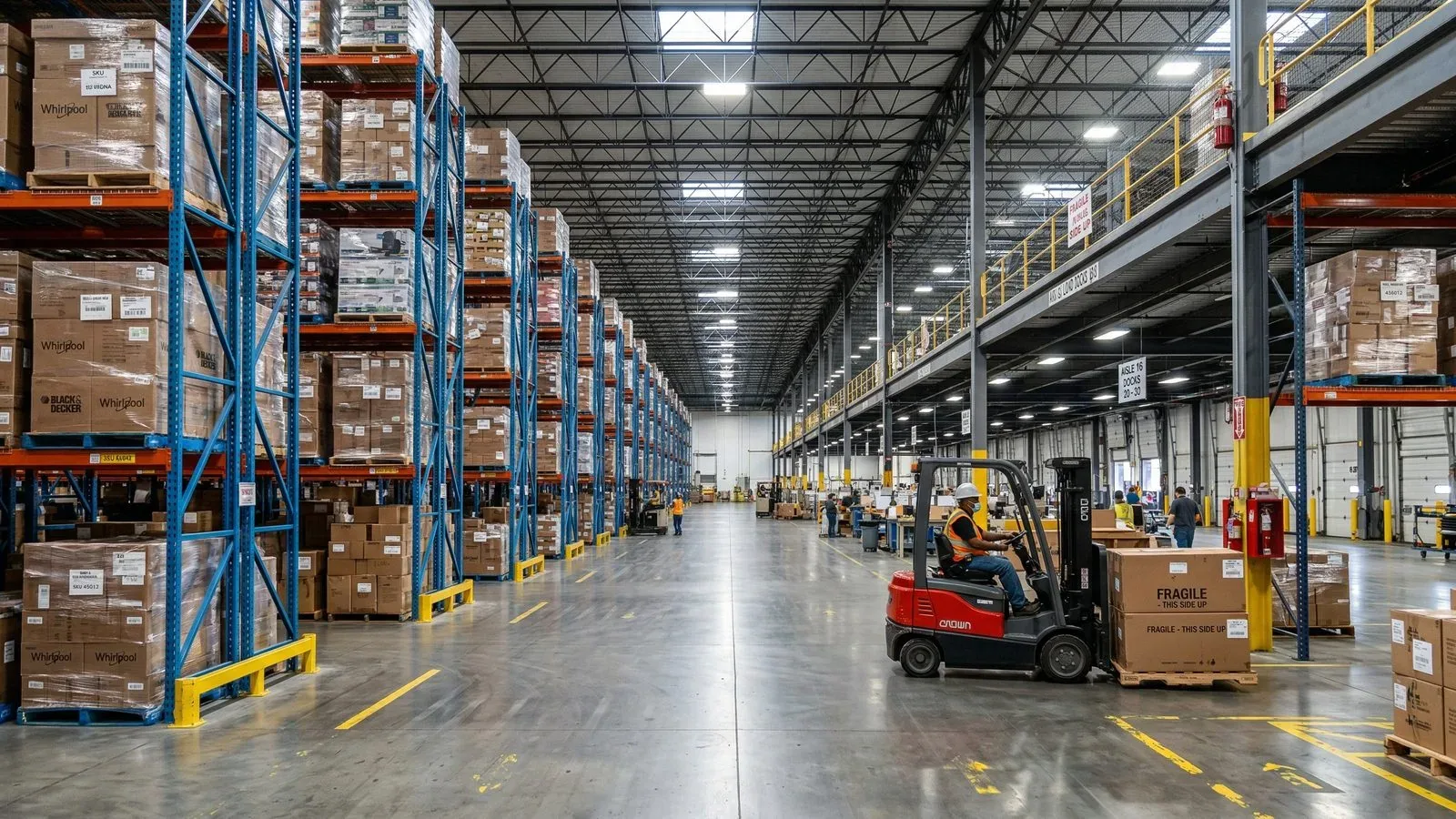
- Carton flow and static shelving integration: E-commerce fulfillment often combines pallet racking (for reserve storage and bulk A-item replenishment) with carton flow lanes and static shelving (for forward pick faces). This hybrid configuration is common in Indianapolis Plainfield fulfillment centers and requires integrated rack design to ensure proper aisle spacing and conveyor routing.
Pick-Path Design for Indianapolis Fulfillment Operations
The physical configuration of your racking directly determines picker travel time — and picker travel time is the largest variable in fulfillment labor cost. In a poorly designed fulfillment center, pickers can walk 8–12 miles per shift covering scattered SKU locations. In a well-designed operation, systematic pick-path design can reduce that to 4–6 miles with no change in order volume.
Pick-path optimization in Indianapolis fulfillment centers typically involves:
- Serpentine vs. return-to-start routing: Serpentine pick paths (where pickers travel down one aisle and back up the next) minimize travel for multi-line orders. Return-to-start paths (where pickers always start and end at the same point) reduce travel for single-line orders. Most Indianapolis fulfillment operations use serpentine routing with WMS-directed batch picking to maximize each trip through the pick zone.
- Zone picking configurations: For very high SKU count operations, dividing the warehouse into pick zones — each handled by a dedicated team — allows pickers to develop deep familiarity with their zone's layout. Zone boundaries should align with rack aisle groupings to avoid split assignments.
- Slotting logic and racking layout: Slotting — the practice of assigning SKUs to specific rack locations based on velocity, weight, size, and co-pick affinity — is a continuous process that evolves as SKU profiles change. Racking design should allow for easy re-slotting without structural modification. This means avoiding fixed-depth shelving where possible in favor of adjustable beam positions.
The interplay between rack layout and pick-path design is one of the most underestimated cost drivers in fulfillment operations. Our warehouse design and space planning service integrates racking layout with operational flow analysis to produce designs that minimize labor cost, not just maximize storage density.
WMS Integration and Rack Configuration
Modern warehouse management systems (WMS) direct every movement in an e-commerce fulfillment center — receiving, putaway, replenishment, picking, packing, and shipping. The rack configuration you build must align with how your WMS will manage locations. Getting this wrong creates operational headaches that are expensive to fix after go-live.
Key WMS-racking integration considerations for Indianapolis fulfillment operations:
- Location labeling standards: Every rack position must be labeled in a format your WMS can parse and direct to. The industry standard is a Zone-Aisle-Bay-Level-Position scheme (e.g., A-01-003-02-01), with barcode and/or RFID tags affixed at each position. Rack installation should include location label placement as part of the installation scope.
- Pick face configuration: Your WMS needs to know the physical dimensions of each pick face — width, depth, and height — to accurately represent capacity and prevent overstock assignments. These measurements come from the rack drawings and must be entered accurately during system configuration.
- Reserve-to-forward replenishment logic: Many Indianapolis fulfillment operations run a two-level racking strategy: reserve pallet storage on upper levels, forward pick faces on lower levels. The WMS triggers replenishment when forward pick faces drop below a threshold quantity. Rack design must support this workflow — forward pick faces need to be accessible by hand (typically below 7 feet), while reserve positions need to be accessible by forklift.
- Conveyor and sort system integration: For operations with conveyor sorters or put walls, rack layout must accommodate the footprint and flow of conveyor infrastructure. Aisles must be wide enough for conveyor supports, and rack bays near conveyor induction points must be accessible without blocking freight flow.
Peak Season Planning: Indianapolis Fulfillment Racking for Q4
E-commerce fulfillment is a seasonal business. Q4 — October through December — can represent 30–40% of annual volume for consumer retail fulfillment operations. Indianapolis fulfillment centers that aren't designed for peak can face severe throughput constraints during the most critical weeks of the year.
Racking design should account for peak season capacity in several ways:
- Reserve storage buffer: Indianapolis fulfillment centers serving Q4-heavy categories (toys, electronics, apparel) typically bring in 6–10 weeks of inventory in September and October. Reserve racking capacity must accommodate this inventory surge without blocking pick aisles or requiring overflow to off-site storage.
- Staging area capacity: Peak volume means more outbound freight staging. Racking design should preserve adequate floor area near dock doors for outbound staging, even if that means accepting slightly lower storage density elsewhere in the facility.
- Temporary racking: Some Indianapolis fulfillment operators bring in temporary modular shelving or deck systems during Q4 to handle the surge. Permanent racking layout should preserve aisle space and floor capacity for temporary additions without requiring reconfiguration of the permanent system.
Getting Started: Fulfillment Racking Design in Indianapolis
The best time to design your Indianapolis fulfillment racking is before you sign a lease — or at minimum, before your TI build-out begins. Racking layout affects dock door requirements, floor flatness specifications, HVAC placement, and fire suppression design. Starting the racking design process after all of those decisions have been made creates constraints that reduce your options and increase cost.
Indy Pallet Racking works with Indianapolis-area e-commerce operators from site selection through installation. Our team has experience with WMS-integrated fulfillment racking, multi-level pick modules, and the permit process in Plainfield, Avon, and throughout the metro. Call us at (317) 597-6252 to schedule a fulfillment racking consultation. There's no charge for initial layout consultations for Indianapolis metro projects.
Fulfillment Racking Design in Indianapolis
From layout design and WMS coordination through permitted installation, Indy Pallet Racking handles e-commerce fulfillment racking across the Indianapolis metro. Call (317) 597-6252.
Get a QuoteReady to Optimize Your Warehouse?
Get a free estimate from Indianapolis's warehouse racking experts. We serve warehouses of all sizes throughout the Indianapolis, IN metro area.